


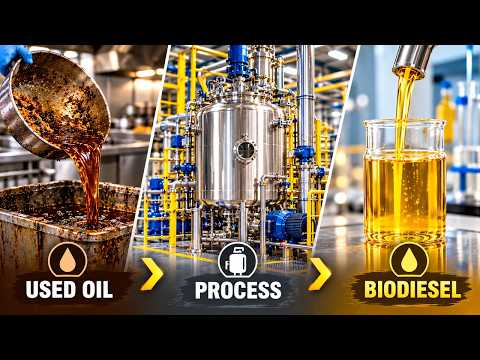
How Used Cooking Oil Becomes Biodiesel Fuel | Recycling Process
How Used Cooking Oil Becomes Biodiesel Fuel reveals the complete journey of waste cooking oil inside a modern recycling factory.
How Used Cooking Oil Becomes Biodiesel Fuel follows discarded restaurant oil through cleaning, conversion, purification, testing and final fuel storage.
15 hours ago • Remade Factory
0
0
1 day ago • Remade Factory
How Broken Windows Become New Glass Tiles | Inside a Glass Recycling Factory
How Broken Windows Become New Glass Tiles reveals the complete glass recycling process inside a modern factory.
How Broken Windows Become New Glass Tiles follows discarded window glass from demolition waste to premium recycled architectural tiles.
What happens after thousands of broken windows arrive at a recycling plant?

0
0
3 days ago • Remade Factory
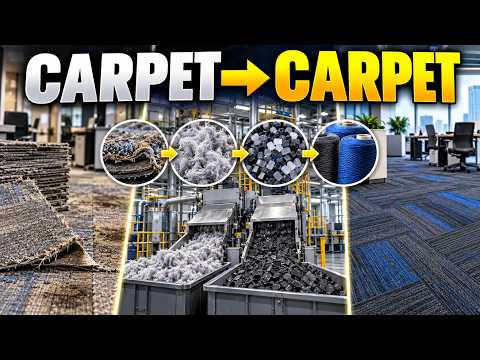
Inside a Factory Turning Old Carpets Into New Carpet Tiles | Carpet Recycling Process
Carpet Recycling Process transforms old commercial carpet tiles into premium new modular flooring inside a modern recycling factory.
Carpet Recycling Process follows worn carpet through material identification, yarn-and-backing separation, nylon regeneration, tufting, backing production and precision tile cutting.
What actually happens when commercial carpet tiles become too worn for an office floor?
Inside this cinematic factory documentary, old carpet tiles first enter a controlled inspection line.
The factory cannot recycle every carpet in exactly the same way.
Face fibers may be Nylon 6, Nylon 6,6, polyester or polypropylene, while backing systems can also vary significantly.
For the closed-loop process shown here, the factory isolates compatible commercial carpet tiles with PA6 Nylon 6 face yarn and recyclable backing.
Loose dust, installation residue and debris are removed before the old tile enters a specialized deconstruction process.
The carpet face is physically separated from the heavy backing.
From that moment, one old product becomes two recycling streams.
The recovered Nylon 6 fiber is cleaned, prepared and inspected before entering a sealed regeneration system.
The old polymer is converted into purified nylon feedstock and rebuilt as regenerated PA6.
That regenerated polymer becomes nylon chips.
The chips are conditioned, colored and melt-spun into thousands of continuous filaments.
Those filaments are drawn, textured and wound into new commercial carpet yarn.
At the same time, the recovered carpet backing is size-reduced, purified and reprocessed into backing feedstock for new flooring.
Then carpet manufacturing begins again.
Regenerated Nylon 6 yarn enters a high-speed tufting machine and forms a new structured loop-pile surface.
The recovered backing material returns as part of the new tile’s backing system.
The completed carpet sheet is consolidated, cooled, stabilized and inspected.
Only then is it precision-cut into modular carpet tiles.
The finished tiles undergo dimensional, visual, bond and durability quality checks before packaging.
Watch until the final reveal to see a worn commercial floor become premium modular flooring again.
0
0